I am the epitome of risk averse person. I drive at (or below) the speed limit. I do not play the lottery or spend money at casinos. I neither gained nor lost a significant amount of money when the price of Bitcoin soared and then inevitably crashed.
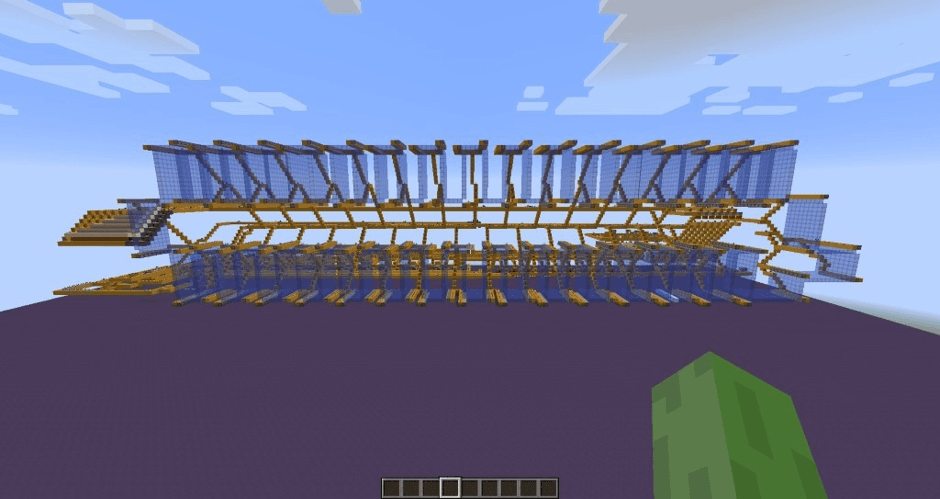
I like to fill my time with low risk activities, like watching Netflix or building functional hard drives in Minecraft.
Working at a startup is, in my opinion, very much like buying a lottery ticket.
Sometimes joining a startup makes a developer into a billionaire. Microsoft, Google, Apple, and Amazon were all once startups. Underfunded, unproven, and with an uncertain future, these companies now have a market value greater than entire countries. Once, for a brief period in 2011, Steve Jobs had more cash on hand than the US government.
Living in Silicon Valley, the evidence of this success was everywhere. On every block and corner new construction financed by the wild optimism of a venture capitalist. Ferraris, Porches, and Teslas in the hundreds on every roadway. One bedroom houses that sold for over a million dollars.
But working for a fledgling corporation is not always shrouded by sunshine and rainbows. For every unicorn (i.e. a startup valued at over one billion dollars) there are hundreds of abject failures. Seventy percent of startups close their doors less than a decade after they start. And even those that don’t crumple don’t usually make it big.
For a developer employed at one of these companies, this has huge implications on job stability, career growth, and income. Although the richest programmers and engineers almost always make their fortunes by building a company from the ground up, the average person working at a startup makes significantly less than a person employed at a stable, well established firm.
So why then, one might ask, did I leave my well-paying job at a Silicon Valley juggernaut, turn down job offers from companies with revenues exceeding $100 billion USD, and relocate to Dallas, TX to work at a startup?
When a recruiter reached out to me on LinkedIn, I had never heard of the company called Hedera. In the message, the recruiter mentioned that Hedera was building a cryptocurrency platform. I had two reactions to this information:
- The first was “That sounds cool!”. My educational and professional background is strongly rooted in databases and distributed systems — distributed ledger technology has always been an area of interest for me.
- My second (and stronger) thought was “Oh no, not one of those!”. There are hundreds, if not thousands, of new cryptocurrencies. Many of these projects, often referred to as “altcoins” (to distinguish them from Bitcoin) are littered with scams and hundreds of dead end designs. Only a handful will ever see growth and adoption.
In the end, curiosity won the battle. I started doing research: watching videos, learning from blog posts, reading technical documentation. And what I discovered surprised me.
Hedera was building a distributed ledger that was practical. And that was a big deal.
I have been following the happenings of the public distributed ledger and blockchain market for a while now. It’s had its ups and its downs, innovations, its wars, and its schisms.
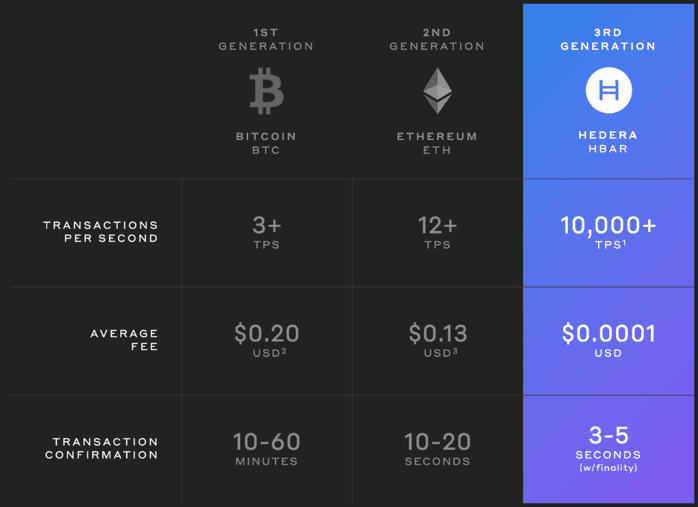
I strongly hold the belief that the reason why Bitcoin and other cryptocurrencies are still a niche product is because they are simply not practical for everyday consumers and commerce. Transaction throughput is severely throttled, payment delays can last for tens of minutes, and network fees are as bad (or worse) than more traditional payment systems.
And so, when I found out that Hedera, a scrappy little startup that had only just opened their network in September, could outperform Bitcoin by a factor exceeding 3,000, I was more than slightly impressed. This was not just an incremental improvement. This was the kind of technological development that could take a tool used by hobbyists and catapult it into the mainstream.
And it wasn’t just a cryptocurrency platform. Similar to some platforms such as Ethereum, Hedera was building a distributed ledger that could support smart contracts, file storage, and consensus services. Only Hedera could do it orders of magnitude faster and cheaper. These services were (gasp)… practical! Developers could actually build high performance and scalable systems using Hedera without spending millions on transaction fees. My mind was blown.
 https://www.hedera.com/hbar
To be honest, I didn’t actually believe it at first. “This was either a hoax or a joke”, I thought to myself. “Or perhaps hyped-up guesswork”. But the more research I did, the more I came to realize that there was something legitimate here.
The straw that broke the camel’s back came when I learned about the Hedera Governing Council. The council is made up of representatives from a variety of companies and is intended to keep the governance of Hedera open and out of the control of any individual interest group. But it wasn’t the existence of this board that hit me hardest, it was the names of the companies that were on it. These weren’t mom-and-pop companies; these were hundred billion dollar behemoths.
This was big. Very big. It was obvious to me that Hedera had the potential to shake the foundation of the global economy, to become a critical piece of infrastructure in the next generation of the internet.
After I interviewed with the company, they offered me a job.
I accepted.
Duh!
Yes, this was a gamble. Yes, I was leaving the safety of an established mega-corporation for the uncertainty of a startup. But I believed (and continue to believe) that there is something special about Hedera. It’s not every day that one gets the opportunity to join a truly disruptive company at the ground floor, and I wasn’t going to waste that opportunity.

Within a month I had my belongings packed and my affairs settled. I put my cats on a plane, waved goodbye to California, and said “hello future”.
***
For more career opportunities at Hedera, visit: